
RKS.23 slewing bearing 834×1048mm
News & Updates
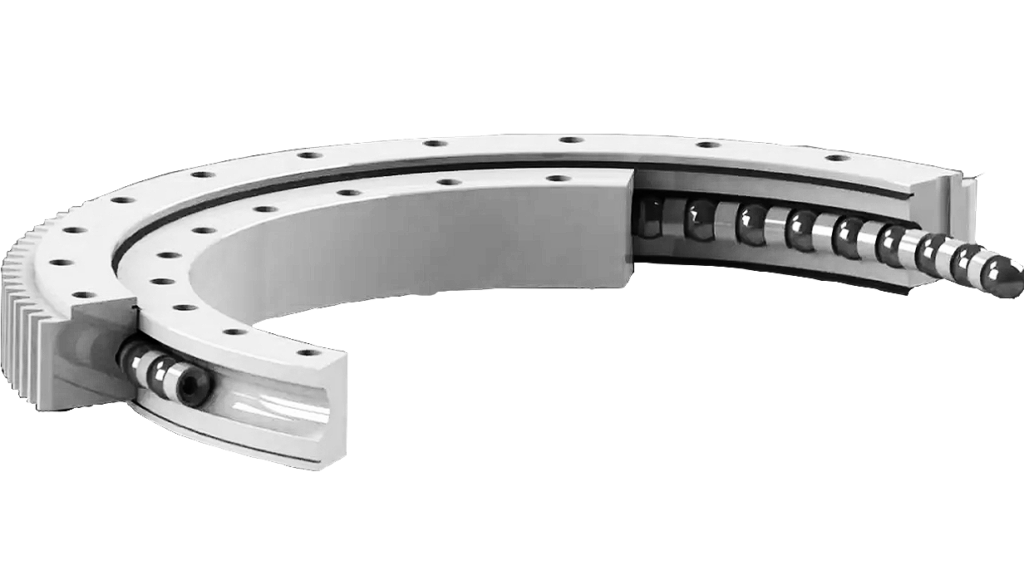
RKS.23 slewing bearing 834×1048mm
Is the RKS.23 0941 a direct replacement for the original European design? In most cases, yes. The 834 × 1048 × 56 mm envelope, the 54 kg mass and the ungeared, double-sealed ring line up with the reference part closely enough that the mounting interface does not change. What deserves a second look is the load case the bearing will actually carry in service.
At a glance
- Parameter: Value
- Bore d: 834 mm
- Outside diameter D: 1048 mm
- Width B: 56 mm
Boundary dimensions: what 834 × 1048 × 56 mm locks in
A 834 mm bore against a 1048 mm outside diameter leaves roughly 107 mm of radial wall between the two surfaces, so the raceway centreline sits near a mean diameter of about 940 mm. Width is 56 mm — a width-to-diameter ratio near 1:17, which is the whole point of the light series. It keeps the 54 kg mass manageable and lets the surrounding structure stay light too.
The trade-off is stiffness. A slim ring deflects more under the same tilting moment than a heavy-series equivalent, so the flatness of whatever it sits on becomes part of the bearing’s load path. Treat the 56 mm width as a stiffness boundary, not a load boundary. If you need more moment capacity at this diameter, a wider series is the correct answer; forcing this ring into a moment-dominated joint is not.
Axial load ratings in context
| Parameter | Value |
|---|---|
| Bore d | 834 mm |
| Outside diameter D | 1048 mm |
| Width B | 56 mm |
| Mass | 54 kg |
| Dynamic axial rating Ca | 231 000 N |
| Static axial rating C0a | 664 000 N |
| Rows | One, four-point contact |
| Sealing | Double sealed |
The static-to-dynamic ratio here is about 2.9, normal for a single-row four-point contact ball ring. Read the static figure as the number that governs your safety factor: for light-load machinery, 3 to 4 against peak static axial load is a sensible starting point. At 150 kN peak axial, s0 lands near 4.4 and the selection is comfortable. At 300 kN peak, s0 is about 2.2 and the deflection of the surrounding structure, not the bearing rating, becomes the thing to check.
Four-point contact means one ball set carries axial load in both directions, radial load and tilting moment — but not all three at full rating at once. If your application is moment-dominated, ask FIJ for the load curve rather than scaling from the axial numbers.
Speed limits and the thermal reality of a metre-wide ring
No single rpm figure is meaningful for a slewing ring of this size, and any published ceiling should be treated as a limit, not a target. Speed here is governed by raceway sliding velocity and seal friction rather than ball spin as in a conventional radial bearing. With a mean raceway diameter around 940 mm, every revolution drags a long contact path past the ball set and both seal lips.
Most light-series rings run below a few revolutions per minute, and many run in slow oscillating motion rather than continuous rotation. That suits the RKS.23 0941 well. If your duty cycle is continuous unidirectional rotation, run a thermal check with FIJ before release.
Mounting considerations
Almost every field problem with a ring this size traces back to the bolted joint rather than the raceway. The points below are the ones FIJ asks about before shipping a replacement:
- Support flatness: check around the full circumference with a straightedge and feeler gauge — a slim ring cannot average out a dished housing.
- Bolt grade and preload: use the grade specified for your hole pattern, torque in a cross pattern in two passes, and re-torque after the first 100 hours.
- Runout verification: record axial runout at four points at 90° before and after torquing so any change is documented.
- Lifting: 54 kg is a two-person or hoist job; sling on the outer ring, never through the bolt holes.
- Seal check: inspect both lips after transport — a nicked lip becomes a slow grease leak.
Under-torqued bolts let the ring flex and shorten raceway life; over-torqued bolts yield and lose preload entirely. The correct figure is the one supplied with the part, not a generic table value.
Sealing and lubrication
The double-sealed configuration keeps grease in and grit out, which matters more for a light-series ring because the slim section has less material available to tolerate a contaminated raceway. Factory fill normally covers commissioning; relubrication intervals then follow the environment rather than the calendar — roughly twelve months in clean indoor duty, three to six in dusty or outdoor duty. Grease purging past the seal lip after a service pass means the cavity is overfilled, not that the seal has failed.
Decoding the series number
The designation RKS.23 0941 breaks down cleanly once you know the convention. RKS identifies the slewing ring family in the original European numbering, .23 marks the light series, and 0941 is the size code tied to this bore and diameter combination. The old code RKS.230941 is the same bearing written without the separator, which matters at data entry — a search for one form will miss the other. Our bearing number reference explains the wider pattern.
Verifying a replacement before you commit
Dimensionally this ring is straightforward. What separates a sound replacement from a marginal one is the documentation behind it: raceway hardness, axial runout records, seal material and a traceable inspection report. Ask for those before the purchase order goes out, and confirm whether your joint is axial-dominated or moment-dominated, since the two require different checks against the load curve.
Ungeared rings across the range are listed in our Light load slewing bearings (No gear type) category, where the RKS.23 0941 can be compared against heavier sections at the same bore. For drawings, application support or a formal quotation, contact FIJ Bearing with your load case and mounting sketch.
Request a quote: send your duty cycle, bolt pattern and peak loads to FIJ and we will confirm whether the RKS.23 0941 suits your joint — or point you to the series that does.