
RKS.122295101002 slewing bearing 571×816mm
News & Updates
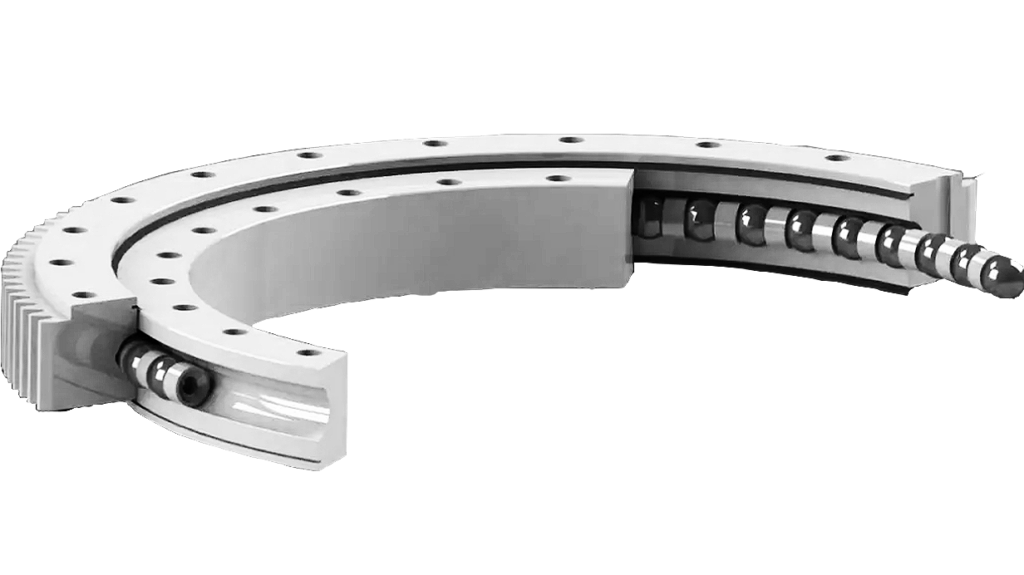
RKS.122295101002 slewing bearing 571×816mm
Sustained eccentric loading routinely destroys conventional slewing rings. When equipment operates under combined axial and radial stress, single-row designs often fail prematurely due to cage wear or raceway fatigue. Engineers solving this problem require a geometry that locks rotational stability without external stiffeners. The customized RKS.122295101002 addresses this by integrating a crossed cylindrical roller configuration within a compact metric envelope. This arrangement distributes contact stresses evenly across the raceways, directly eliminating deflection under heavy payloads.
At a glance
- Parameter: Value
- Inner Diameter: 571 mm
- Outer Diameter: 816 mm
- Section Width: 90 mm
Geometric Architecture & Dimensional Precision
Boundary dimensions dictate mounting constraints long before load calculations begin. With an inner diameter of 571 mm and an outer diameter of 816 mm, this unit balances structural rigidity with minimal material bulk. The overall thickness width measures precisely 90 mm. Engineers typically consolidate these measurements into a quick reference matrix before finalizing housing designs.
| Parameter | Value |
|---|---|
| Inner Diameter | 571 mm |
| Outer Diameter | 816 mm |
| Section Width | 90 mm |
| Net Mass | 125 kg |
These figures reflect standardized metric manufacturing. Machinists calculate shaft clearances and housing tolerances using standard ISO fits. Precise boundaries also simplify gasket seating and fastener alignment during field assembly.
Load Capacity & Contact Mechanics
Axial force resistance drives component selection. Static load rating axial performance reaches 1,880,000 N, indicating the stationary weight threshold before permanent indentation occurs in the contact zones. Dynamic capacity follows, listing a ca dynamic load rating axial value of 495,000 N. This governs fatigue life under continuous rotational stress. Because the design utilizes one row of precisely ground cylindrical rollers arranged at ninety-degree angles, the cross-contact geometry eliminates skewing forces that plague traditional ball bearings under pure axial dominance.
Flat-end roller surfaces transfer thrust loads directly into hardened steel races. The result is predictable L10 life calculations and reduced maintenance intervals for cranes and heavy-duty turntables.
Sealing Strategy & Thermal Management
Contamination ingestion ruins rotating assemblies within hours. Dust, water spray, and abrasive particulates bypass inadequate seals, turning smooth rotation into grinding noise. To combat this, a double sealed architecture surrounds the roller package. Multiple lip configurations combine with preloaded contact seals to create a positive barrier that retains factory grease while excluding external debris.
The following operational benefits stem directly from this sealing methodology:
- Extended relubrication intervals reduce scheduled downtime
- Minimal frictional heat buildup protects adjacent electronics
- Maintained preload consistency prevents positional drift
Temperature fluctuations further challenge lubrication integrity. The specified operating temperature range spans from -40 to 110 °C. Subzero conditions require synthetic greases that maintain viscosity, preventing startup torque spikes. Higher temperatures demand polymer compounds that retain elasticity. This thermal window covers most terrestrial applications without specialized coolant jackets.
Integration & Engineering Validation
Matching OEM specifications to local equivalents requires rigorous tolerance stacking. The unit aligns with the original European design reference found in international catalogs, yet it undergoes independent vibration testing and surface profiling at our facility. Professionals exploring the Crossed roller slewing bearings (No gear type) category will find consistent quality controls applied across every batch. Heat treatment achieves core microstructures optimized for impact resistance, while raceway finishes remain below Ra 0.2 microns to minimize frictional heating.
Field replacements demand exact dimensional replication. Every incoming lot receives hardness mapping and rotational play verification before dispatch. Engineers verifying cross-compatibility across regional supply chains should consult a dedicated bearing number reference for exact catalog mapping. Our engineering team provides detailed mounting drawings and recommended lubrication schedules.
Contact our technical team to Request a quote for project-specific modifications or volume pricing through FIJ.