
L18QA208T four-point contact ball bearing 64×76.2mm
News & Updates
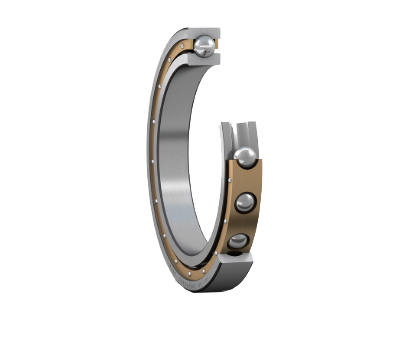
L18QA208T four-point contact ball bearing 64×76.2mm
Space-Constrained Load Architecture
At a glance
- Specification: Value
- Model Number: L18QA208T
- Series: L18QA
- Type: 4-POINT CONTACT, X-TYPE, Thin Section
Space-constrained mechanisms frequently suffer from housing interferences when designers overlook outer race curvature relative to shaft allowances. When every millimeter dictates performance, the L18QA208T eliminates structural guessing by delivering optimized geometry within a razor-thin cross section. Engineers select this component exclusively for servo assemblies, optical staging platforms, and aerospace actuators where standard deep groove units physically cannot clear adjacent shielding or shoulder features.
Boundary Dimensions & Cross Section
The boundary dimensions anchor the entire mechanical layout. With a nominal inside diameter of 64 mm and an outside diameter of 76.2 mm, the component bridges moderate torque transmission and rigid support roles. A cross section width of merely 6.35 mm permits shallower clearance pockets than traditional housings allow. This volume reduction lowers rotating mass and decreases inertial loads during rapid directional changes. Dimensional consistency remains strict across production runs to guarantee uniform preload behavior.
| Specification | Value |
|---|---|
| Model Number | L18QA208T |
| Series | L18QA |
| Type | 4-POINT CONTACT, X-TYPE, Thin Section |
| Bore Configuration | Cylindrical Bore |
| Inside Diameter (d) | 64 mm |
| Outside Diameter (D) | 76.2 mm |
| Width (B) | 6.35 mm |
| Weight | 0.0590 kg |
| Basic Dynamic Radial Load (Cr) | 2251 N |
| Limiting Speed | 4272 r/min |
Four-Point Contact Load Distribution
Unlike standard single-row configurations, the hardened steel balls engage both raceways at forty-five-degree angles simultaneously. This four-point contact architecture enables efficient handling of combined force vectors within a minimized envelope. Radial stress evaluation shows a basic dynamic rating of 2251 N, while static resistance holds at 2397 N before yield deformation begins. Axial thrust behaves differently; the unit provides a dynamic axial capacity of 7331 N, though static axial tolerance falls to 1648 N under pure unidirectional loading. Operating points must remain safely beneath these curves to preserve elastic Hertzian contact zones and prevent premature brinelling during impact events.
Rotational Velocity & Thermal Limits
Maximum operating speed depends entirely on centrifugal forces, cage integrity, and lubricant shear limits. At a cataloged limiting speed of 4272 r/min, the inner ring generates significant outward traction that fights against the rolling elements. Sustained operation beyond this ceiling rapidly depletes fatigue life and induces thermal escalation from churning friction. Applications running near 4000 r/min require synthetic base oils with high thermal stability and forced ventilation channels. Low-viscosity formulations reduce hydrodynamic drag but sacrifice the boundary film essential during startup transients. Always validate duty cycles against real-time temperature spikes rather than assuming catalog ceilings apply universally.
Mounting Geometry & Shaft Fit
Installation procedures demand strict adherence because the cylindrical bore offers no built-in alignment compensation. Reliable assembly depends on controlled induction heating or press-fit methodology to seat the inner ring without hammer-induced metallurgical damage. Mating shaft surfaces require a finish near Ra 0.8 μm to eliminate fretting pathways during micro-slip cycles. Housing bores should conform to ISO k6 standards to ensure outer race retention without forcing excessive diametral preload. Angular misalignment exceeding 0.05 degrees quickly concentrates contact stress along specific arc segments.
System Integration & Procurement Logic
Validating component suitability requires methodical pre-installation checks:
- Verify shaft and housing fits align with DIN ISO clearance specifications
- Calculate equivalent dynamic bearing load against anticipated duty cycles
- Select lubrication methods compatible with peak operating temperatures
- Measure mounting surface runout under maximum transmitted torque
- Cross-reference internal part codes via the bearing number reference repository
For broader architectural compatibility, review the thin section four-point contact ball bearings category engineered for compact mechanical architectures. Integrating the L18QA208T reduces overall system mass while maintaining rigid load paths across demanding cycles. Consult our applications department at FIJ Bearing for tolerance verification or volume scheduling. Request a quote for rapid prototyping and production scaling.