
Bearings for Aerospace and Aviation: A Complete Guide
News & Updates
Bearings for Aerospace and Aviation: A Complete Guide
Bearings for aerospace and aviation are among the most tightly specified mechanical components in modern engineering. A commercial aircraft may carry thousands of bearings across its engines, flight controls, landing gear, and accessory systems, and each one operates under conditions that would destroy a standard industrial bearing within hours. Extreme temperatures, high rotational speeds, vibration, corrosion exposure, and the absolute requirement for reliability in flight all shape how these components are designed, manufactured, and certified.
This guide provides a comprehensive introduction to aerospace bearings: what they are, where they are used, how they are made, which standards govern them, and how engineers and procurement teams should approach selection. Whether you are specifying components for a new airframe program or sourcing replacements for an MRO line, understanding the aerospace bearing landscape is essential to making sound technical and commercial decisions.
What Makes Aerospace Bearings Different
At first glance, a bearing is a bearing: rolling elements, rings, and a cage designed to carry load while minimizing friction. In aerospace, however, the performance envelope is dramatically narrower and the consequences of failure are far more severe. Several factors distinguish aerospace bearings from their industrial counterparts:
- Weight sensitivity: Every gram matters in aircraft design. Aerospace bearings are engineered to deliver maximum load capacity and stiffness at minimum mass, often using thin-section rings and lightweight cages.
- Temperature extremes: Engine bearings may see continuous operating temperatures above 200°C, with short-term excursions far higher. Airframe bearings must function from -55°C at altitude to high temperatures near hydraulic and pneumatic systems.
- Speed and load: Main shaft engine bearings operate at DN values (bore diameter in mm multiplied by speed in rpm) that push lubricant and material limits.
- Certification and traceability: Every flight-critical bearing must be traceable from raw material to finished part, with documented heat treatment, inspection, and test records.
- Lubrication constraints: In many applications, bearings must run with limited or sealed-for-life lubrication, or with specialized oils and greases qualified for aviation use.
These requirements drive specialized materials, tight tolerances, and rigorous quality systems that go well beyond typical industrial bearing production.
Where Bearings Are Used in Aircraft
Aerospace bearings appear in nearly every mechanical system on an aircraft. The major application groups include:
Engine and Turbine Systems
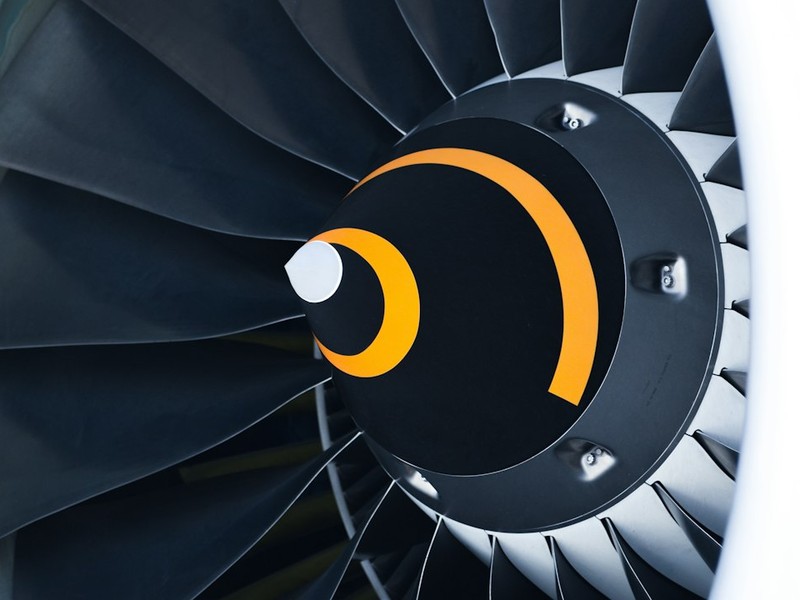
Turbine engines rely on main shaft bearings to support the fan, compressor, and turbine rotors at high speed and temperature. These positions typically use precision roller bearings and angular contact ball bearings made from specialized steels or ceramic hybrid designs. Accessory gearboxes, fuel pumps, and starter systems also depend on compact, high-reliability bearings.
Airframe and Flight Controls
Airframe bearings support control surfaces, actuators, linkages, and structural joints. They must combine low friction with high static load capacity and resistance to corrosion and fretting. Rod end bearings, spherical plain bearings, and thin-section ball bearings are common in these positions.
Landing Gear and Actuation
Landing gear bearings carry heavy shock loads during touchdown and must resist corrosion from runway environments. Precision roller bearing designs are frequently specified for wheel and strut applications, while Precision slewing bearing solutions appear in actuation and rotation systems where combined loads must be managed.
Avionics, Accessories, and Cabin Systems
Small precision bearings support gyroscopes, actuators, fans, and instrumentation. Here, Precision ball bearing designs dominate because of their low torque, quiet operation, and ability to run with minimal lubrication.
Common Bearing Types in Aerospace Applications
Although many bearing families exist, a relatively small number dominate aerospace and aviation use:
- Angular contact ball bearings: Used in engine and gearbox positions where combined radial and axial loads must be carried at high speed.
- Cylindrical and spherical roller bearings: Selected for high radial load capacity in main shaft and gearbox applications.
- Thin-section ball bearings: Preferred where space and weight are critical, such as control surface and instrument applications.
- Spherical plain and rod end bearings: Provide articulation in linkages and structural joints.
- Ceramic hybrid bearings: Combine steel rings with ceramic balls to reduce weight, lower friction, and improve high-speed performance.
- Slewing and turntable bearings: Used in rotating actuation systems where combined loads and moment loads must be supported.
Each type brings trade-offs in load capacity, stiffness, speed capability, and lubrication demand. Selection should always begin with the operating conditions, not with a preferred bearing family.
Materials and Coatings
Material choice is central to aerospace bearing performance. Standard through-hardening steels such as 52100 are used in some airframe positions, but higher-demand applications typically require more specialized alloys:
- M50 and M50 NiL: High-speed tool steels widely used in turbine engine bearings for their hot hardness and fatigue resistance.
- 440C and 440C-based stainless steels: Common in airframe and instrument bearings where corrosion resistance is important.
- Ceramics: Silicon nitride balls reduce weight and thermal expansion while improving speed capability.
- Coatings: Thin dense chromium, titanium nitride, and specialized solid film lubricants are applied to reduce wear and fretting in marginal lubrication conditions.
Cages are equally important. Materials range from stamped steel and machined bronze to engineered polymers and composites, each chosen for temperature range, lubricant compatibility, and dynamic behavior.
Standards, Certification, and Quality Control
Aerospace bearings are governed by a layered framework of standards. At the quality system level, AS9100 is the baseline for aerospace suppliers, with NADCAP special process approvals often required for heat treatment, coating, and nondestructive testing. At the component level, specifications from SAE, ISO, and OEM-specific documents define dimensions, tolerances, material properties, and inspection methods.
Traceability is non-negotiable. A typical flight-critical bearing is accompanied by a documentation package that includes material certifications, heat treatment records, dimensional inspection reports, and where required, dynamic test data. Buyers should verify that a supplier can provide this documentation consistently, not just on first article.
For a manufacturer like FIJ, meeting these requirements means controlling every step of production: raw material sourcing, machining, heat treatment, grinding, assembly, and final inspection. Precision bearing manufacturing for aerospace is as much about process discipline as it is about equipment.
Selection Criteria for Engineers and Buyers
Choosing the right bearing for an aerospace application involves balancing technical performance with supply chain realities. Key criteria include:
- Load and speed profile: Define radial and axial loads, speed range, and duty cycle before selecting a bearing type.
- Temperature environment: Match material, lubricant, and cage to the maximum continuous and peak temperatures.
- Lubrication strategy: Decide between oil jet, grease, sealed-for-life, or dry film lubrication based on maintenance access and operating conditions.
- Corrosion and contamination exposure: Specify stainless steels or coatings where moisture, salt, or chemicals are present.
- Weight and envelope: Use thin-section or hybrid designs where mass and space are constrained.
- Certification and traceability: Confirm the supplier’s quality system, documentation practices, and ability to support audits.
- Lead time and lifecycle support: Aerospace programs run for decades; ensure long-term availability and consistent configuration control.
Early engagement with the bearing supplier often pays dividends. Designers who involve manufacturing engineers during concept development can avoid costly redesigns later, particularly when tolerances, materials, or lubrication strategies are still flexible.
Maintenance, Inspection, and Replacement
Even the best bearing has a finite life. In aviation, maintenance programs rely on scheduled inspection, condition monitoring, and life-limited part replacement. Vibration analysis, oil debris monitoring, and borescope inspection help detect early signs of wear or lubrication breakdown.
When replacement is required, using bearings from the original specification or an approved equivalent is critical. Substituting a lower-grade component to save cost can compromise safety and invalidate certifications. MRO organizations should work with suppliers who understand aerospace documentation requirements and can deliver consistent, traceable parts.
Trends Shaping Aerospace Bearings
Several trends are influencing how bearings for aerospace and aviation are designed and sourced:
- More electric aircraft: As hydraulic systems give way to electric actuation, bearings face new speed, duty cycle, and thermal profiles.
- Additive manufacturing: Emerging for cages and specialized components, though flight-critical rolling elements remain conventionally manufactured.
- Hybrid and ceramic solutions: Growing adoption in high-speed and high-temperature positions.
- Digital traceability: Blockchain and digital thread initiatives aim to streamline certification and lifecycle documentation.
- Supply chain resilience: OEMs and MROs are diversifying suppliers and prioritizing partners with strong quality systems and reliable lead times.
Bearings for aerospace and aviation represent a demanding intersection of precision engineering, materials science, and quality assurance. From turbine engine main shafts to flight control linkages, these components must perform reliably in conditions that leave little margin for error. Understanding the application landscape, material options, certification requirements, and selection criteria is the foundation for making sound decisions.
For engineers and buyers, the priority is clear: work with manufacturers who can demonstrate process control, documentation discipline, and long-term support. As a precision bearing manufacturer serving demanding industries, FIJ focuses on delivering components that meet these expectations, from Precision ball bearing designs to Precision roller bearing and Precision slewing bearing solutions. Whether you are developing a new aerospace program or sustaining an existing fleet, a disciplined approach to bearing selection and sourcing will protect performance, safety, and cost over the full lifecycle.