
S71906 High precision angular contact ball Bearing — 30×47mm
News & Updates
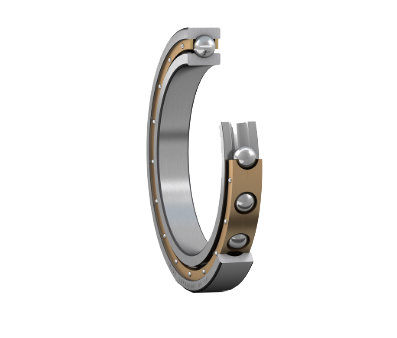
S71906 High precision angular contact ball Bearing — 30×47mm
Spindle vibration that appears only at higher speeds is often a preload and cage-stability problem, not a housing problem. The S71906 answers that class of fault with a sealed, single-row super-precision angular contact design in a 30×47mm envelope: 30 mm bore, 47 mm outside diameter and 18 mm width. In the 71900 series it is a compact positioning bearing for buyers who need controlled axial stiffness, low running torque variation and protection from coolant or dust ingress in the same package.
At a glance

- Model: S71906 CD/P4ADGB, 71900 series.
- Boundary dimensions: 30 mm bore × 47 mm OD × 18 mm width; 0.099 kg.
- Load ratings: Cr 10,621 N and Cor 8,990 N radial.
- Fit and form: single-row super-precision angular contact, cylindrical bore, sealed both sides.
- Best use: compact spindle and precision positioning axes needing rigid, protected bearing support.
What do the 30×47×18 mm boundary dimensions mean?
The bore, outside diameter and width are not just catalogue numbers; they set shaft journal, housing bore and axial stack. On the S71906 the 30 mm bore and 47 mm outside diameter create a compact radial section, while the 18 mm width defines the space needed for the rings, cage and sealing arrangement.
Because the bearing is sealed both sides, the housing shoulder and locknut must clear the seal faces across the full 18 mm width. Confirm fillet radii and abutment dimensions before locking the design; a correct 30×47mm envelope will not compensate for a housing shoulder that touches a seal.
| Parameter | Value |
|---|---|
| Series | 71900 series (S719..CD/P4ADGB) |
| Type | Super-precision angular contact ball bearings, single row |
| Bore d | 30 mm |
| Outside diameter D | 47 mm |
| Width B | 18 mm |
| Weight | 0.099 kg |
| Basic dynamic radial load rating Cr | 10,621 N |
| Basic static radial load rating Cor | 8,990 N |
| Cage | Cotton fabric reinforced phenolic resin or carbon fibre reinforced PEEK, outer ring centred |
| Sealing | S = Seal on both sides |
| Bore type | Cylindrical |
What do the 10,621 N and 8,990 N load ratings mean?
Cr 10,621 N is the basic dynamic radial load rating used for fatigue-life calculations under rotating load. Cor 8,990 N is the basic static radial rating, relevant to peak loads, standstill conditions and shock events that can leave brinelling marks on the raceways.
Read these figures as radial ratings, not as a blanket axial capacity. Acceptable axial load and stiffness depend on contact angle, preload and mounting arrangement, so request an application-specific axial curve rather than applying the radial number to a thrust duty.
Why is the cage and seal specification important?
The cage is specified as cotton fabric reinforced phenolic resin or carbon fibre reinforced PEEK, outer-ring centred. That detail matters at speed: an outer-ring-centred cage has a defined guide surface, helping control ball motion and lubricant distribution when centrifugal effects build.
The “S” in the designation means seals on both sides, so the bearing arrives protected against dust and coolant ingress and with grease retained in the raceway. For clean-room or instrument assemblies this sealing is useful, but seal lips add torque; if maximum speed is the priority, compare sealed versions with open variants in the High precision angular contact ball bearings category before finalising.
How should this angular contact bearing be installed and preloaded?
Angular contact bearings are direction-sensitive. Fit the bearing with the marked thrust face against the shoulder specified for the arrangement, and press only on the ring being fitted. Never transmit mounting force through the balls or cage.
For a P4ADGB precision designation, treat preload and pairing as part of the bearing function: measure axial clearance or preload after assembly, not by feel alone. Work clean and keep seals undamaged; a trapped chip under a seal lip can shorten life faster than a small preload error in many low-speed assemblies. Use the bearing number reference to decode suffix order, but confirm the drawing for the exact P4ADGB arrangement.
Which applications suit a sealed 30×47mm super-precision bearing?
The best fit is a compact axis where radial space is tight and the bearing must locate the shaft in both directions through a paired or preloaded arrangement. Typical candidates include small spindle modules, precision rotary tables, optical adjustment axes and test-stand bearing packs.
The sealed design is most valuable where coolant, dust or lubricant loss would otherwise dictate a separate shield. It is less suitable for an application that demands relubrication through the outer ring or extreme speed beyond the seal and cage limits; check those limits with FIJ Bearing before release.
What should buyers verify before ordering?
Buyers should match the complete designation, not just the 30×47×18 mm size. This bearing has sealing, cage and precision suffix choices that change torque, speed and mounting. Confirm bore type is cylindrical, the cage material is acceptable for your temperature and speed, and the load ratings are applied as radial values unless an application-specific axial rating is supplied. Weight at 0.099 kg is useful for inertia calculations, but it should not replace a drawing check for chamfer and shoulder dimensions.
Ask for the inspection record, preload or clearance statement and seal material confirmation. A sealed precision bearing is a system component; the purchase order should state the exact suffix, packaging protection and traceability. If you are comparing cross-references, use dimensional and performance data rather than a translated part number.
Request a quote for S71906 from FIJ Bearing.