
PC300ARO angular contact ball bearing 762×781.05mm
News & Updates
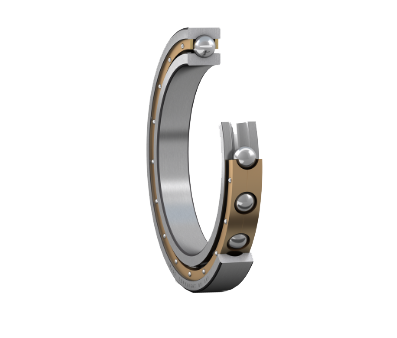
PC300ARO angular contact ball bearing 762×781.05mm
A 762 mm bore with only 9.525 mm of axial width leaves almost no room for a conventional angular contact pair. That is the constraint the PC300ARO is built around: a thin-section angular contact ball bearing for large-diameter assemblies where axial space is fixed by the housing, not by the bearing catalogue. In a Thin section angular contact ball bearings category review, the first question is rarely “what is the load rating?” It is “which drawings, suffixes and interchange listings actually describe the same ring set?”
At a glance
- Parameter: PC300ARO data
- Bore diameter, d: 762 mm
- Outside diameter, D: 781.05 mm
- Width, B: 9.525 mm
What 762 × 781.05 × 9.525 mm Changes in the Design
The envelope is the defining feature. A 762 mm inside diameter against a 781.05 mm outside diameter gives a very thin radial wall, and the 9.525 mm width keeps the bearing compact in the axial direction. That geometry suits slow-moving, large-bore equipment such as positioners, turntables and specialized inspection fixtures, but it also means the ring stiffness, ball complement and contact angle must be treated as a system.
| Parameter | PC300ARO data |
|---|---|
| Bore diameter, d | 762 mm |
| Outside diameter, D | 781.05 mm |
| Width, B | 9.525 mm |
| Weight | 1.456 kg |
| Basic dynamic radial load rating, Cr | 15,840 N |
| Basic static radial load rating, Cor | 79,890 N |
| Limiting speed | 660 r/min |
The static radial rating of 79,890 N is substantially higher than the 15,840 N dynamic radial rating, which is typical of thin-section angular contact designs expected to carry positioning loads and occasional shock rather than continuous high-speed rotation. The 660 r/min limiting speed should be read as a boundary condition, not a target. Lubrication, preload and mounting stiffness can move the practical ceiling lower.
Weight is another clue: 1.456 kg for a bearing with a 762 mm bore indicates how aggressively material has been removed. That is why a simple dimensional substitute can be risky. Two bearings can share the same 762 × 781.05 × 9.525 mm envelope and still differ in raceway curvature, ball size, cage material, contact angle and preload class. Each of those changes affects axial stiffness, starting torque and heat generation.
Reading PC300ARO Cross-References Beyond the Envelope
Cross-reference lists usually start with boundary dimensions, then add a family code. In the PC300ARO, “300” points to a thin-section series context, while “ARO” should be verified against the controlled drawing rather than treated as a universal interchange key. A supplier may list an equivalent under a different suffix, a legacy drawing number or an in-house code. That is useful for finding candidates, not for proving fit.
For buyers, the practical route is to use a bearing number reference to decode the series and then compare the data that actually controls performance: contact angle, preload or axial clearance, radial internal clearance, ball complement, cage type, and allowable misalignment. If a legacy drawing cites the original European design, ask for the controlled drawing and the inspection report. A converted number without those documents is only a lead.
Interchange programs also vary in how they treat angular contact bearings. Some return a direct dimensional equivalent and leave preload to the buyer. Others group thin-section bearings by envelope and load class, which can hide differences in contact angle. For a large-bore assembly, that difference can show up as axial play at the tooling interface, uneven raceway loading, or a preload that collapses after the first thermal cycle. The safest comparison is drawing-to-drawing, not number-to-number.
Interchange Checks for Buyers and Maintenance Engineers
For PC300ARO replacement planning, treat the interchange exercise as an engineering review with a short list of hard checks. The list below is the minimum I would expect before a thin-section angular contact bearing is released into a large-bore assembly.
- Envelope and mounting: confirm 762 mm bore, 781.05 mm outside diameter, 9.525 mm width, corner radii, shoulder clearances and axial clamping arrangement.
- Contact angle and preload: match the original axial stiffness and starting torque; do not assume that a dimensional equivalent has the same preload class.
- Load ratings: compare radial dynamic and static ratings, but also check the expected axial component and shock load, because angular contact bearings share load differently from deep groove bearings.
- Ball complement and cage: verify ball size, count, cage material and guidance; these details influence speed, lubrication retention and wear behavior.
- Speed and lubrication: treat 660 r/min as a reference limit and confirm the actual oil or grease regime, operating temperature and heat dissipation.
- Documentation: request material certificates, dimensional report, runout data and preload verification for any cross-referenced substitute.
An interchange program can shorten the search, but it should not shorten the verification. If the application includes axial location, repeated indexing or thermal cycling, a slight change in contact angle can be more important than a few percent difference in static rating.
Where PC300ARO Fits in an Interchange Program
In an interchange program, PC300ARO sits in a narrow category: large-bore, thin-section, angular contact, relatively low-speed. That makes it a poor candidate for casual substitution with a deep groove ball bearing or a standard-width angular contact bearing, even if the shaft and housing can be modified. The value of the bearing is the combination of a very thin axial section and controlled angular contact geometry. Change either one and the assembly’s axial stiffness and mounting preload may no longer match the original design intent.
The better use of cross-references is to build a shortlist. Confirm the envelope, then compare drawings, ratings and preload data, then request inspection records. For maintenance teams, keep the original part number, the controlled drawing revision and the measured mounting clearances together. For OEM buyers, specify the contact angle, preload and cage requirements in the purchase description rather than relying on a catalogue suffix alone.
FIJ supplies this thin-section angular contact ball bearing with dimensional and inspection data matched to the application, and can review interchange candidates against the controlled drawing rather than a generic cross-reference list. Request a quote from FIJ Bearing with your mounting drawing, preload requirement and operating speed so the comparison starts from the same engineering basis.