
230.20.0800.503 slewing bearing 734×948mm
News & Updates
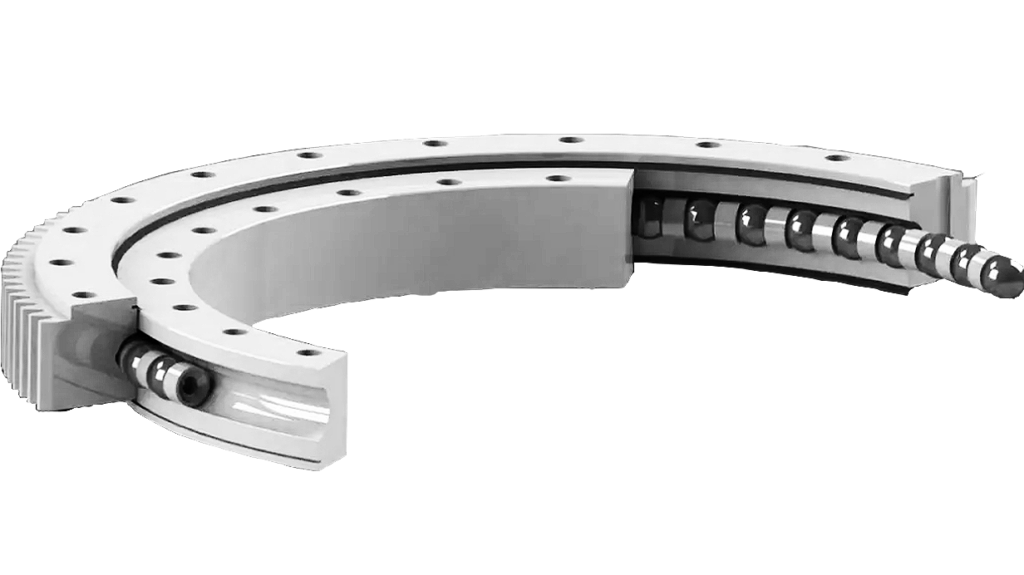
230.20.0800.503 slewing bearing 734×948mm
Model 230.20.0800.503 defines a Light load slewing bearings (No gear type) unit with boundary dimensions of 734 × 948 × 56 mm. The primary identifier encodes a reference to Rothe Erde geometry within the Flanged Series 25 family. Dimensional notation follows standard ISO practice where the first value indicates the inside diameter, the second the outside diameter, and the third represents the cross-section thickness. This specific configuration utilizes a single-row ball raceway architecture designed for moderate oscillatory duty without integrated gearing mechanisms.
At a glance
- Specification: Value
- Model Number: 230.20.0800.503
- Inner Diameter (d): 734 mm
- Outer Diameter (D): 948 mm
Boundary Dimensions and Profile Geometry
The internal bore measures 734 mm, accommodating shaft assemblies requiring high torsional stiffness while minimizing rotational inertia. An external diameter of 948 mm establishes the footprint for flange mounting surfaces, providing adequate structural support for axial force transfer. The width dimension of 56 mm classifies this component as a lightweight profile ring, reducing overall system mass compared to multi-row configurations. Weighing 47.1 kg, the ring balances durability with transport efficiency.
Engineers should verify clearance envelopes against adjacent machinery housings to ensure adequate space for sealant application and fastener access around the perimeter. The 734 mm ID allows for potential cable routing through the center, eliminating the need for external slip rings in some signal applications. The 948 mm OD dictates the mounting hole circle radius, influencing the structural rigidity of the supporting frame. A thicker section would increase stiffness but add mass; the 56 mm profile offers a calculated compromise for light load applications. When evaluating transport logistics, note that the 47.1 kg weight exceeds manual handling thresholds, recommending the use of lifting eyes or slings secured to flange bolts. Verify that the housing bore tolerance permits the necessary interference fit or clearance for thermal expansion, particularly if aluminum alloy housings are employed alongside steel rings.
Load Capacity and Structural Ratings
Static analysis reveals a basic static load rating of 510,000 N in the radial direction. This capacity supports substantial transverse forces during operational pauses or shock loading events. For rotating applications, dynamic load calculations must account for fatigue life expectations and lubricant film formation. The single-row construction distributes contact stresses across hardened steel balls running between profiled rings.
Cage selection influences high-speed viability; Nylon cages offer self-lubricating properties suitable for medium-duty cycles, while Stainless Steel variants provide enhanced thermal stability for elevated temperature environments. When moment loads exist, such as overturning forces from wind or eccentric payloads, the effective load zone widens along the raceway. Skewing calculations become critical near the static limit to prevent edge loading that could initiate spalling. Lubrication regime must be maintained within hydrodynamic boundaries to separate metallic surfaces. For the 230.20.0800.503, designers calculating equivalent dynamic load $P$ must integrate radial, axial, and moment loads using vector summation methods defined in ISO 76. Consider adding a grease nipple assembly compatible with the 56 mm width to facilitate periodic relubrication without disassembly.
| Specification | Value |
|---|---|
| Model Number | 230.20.0800.503 |
| Inner Diameter (d) | 734 mm |
| Outer Diameter (D) | 948 mm |
| Width / Thickness (B) | 56 mm |
| Weight | 47.1 kg |
| Basic Static Load Rating (Radial) | 510,000 N |
| Precision Grade Options | P0, P6, P5 |
| Seal Configuration | Double Sealed |
Speed Limits and Thermal Management
Rotational velocity constraints depend heavily on cage material selection and centrifugal forces acting on the rolling elements. At peripheral speeds exceeding practical thresholds, standard polymer cages may experience degradation, necessitating a switch to metal reinforcement or alternative designs. Heat generation arises from friction losses within the contact zones and churning of the lubricant medium. Effective thermal management requires monitoring surface temperatures during prolonged operation.
As rotational speed increases, centrifugal force pushes balls outward, altering contact angles and increasing sliding friction. The maximum speed limit is not a fixed number but a function of grease rheology and cage dynamics. Nylon cages generally handle moderate speeds well due to lower inertia, yet chemical resistance to certain synthetic greases must be verified. For speeds approaching the thermal limit, oil-air mist lubrication may be superior to grease. The double seal adds drag; evaluate whether labyrinth seals would reduce friction if contaminants are excluded by other means. Always calculate the $dm \times n$ value against manufacturer charts to ensure the bearing operates within its safe velocity envelope. This parameter accounts for both mean diameter and rotational speed, serving as a primary indicator for heating trends.
Mounting Interfaces and Precision Grades
Machining tolerances directly impact kinematic accuracy and noise performance. This bearing supports precision grades ranging from P0 general engineering quality to P5 high-precision standards, allowing alignment with specific motion control requirements. Flange bolt holes require careful attention to position tolerances and perpendicularity relative to the raceway axis to prevent preload-induced distortion.
Precision grade P5 imposes tighter runout tolerances, requiring highly accurate machining of the mounting faces. Parallelism deviations greater than permitted can induce elastic deformation in the ring, creating preload hotspots that accelerate wear. Use leveling shims if flatness issues arise on the base plate. Corrosion protection is vital; apply anti-seize compound to threads and bearing bores to prevent galling during removal. After installation, rotate the ring manually to check for binding. Any rough spots indicate debris inclusion or misalignment. Document the angular position during mounting to facilitate future reassembly if the unit is serviced. Torque sequence during installation must follow a crisscross pattern to achieve even clamping force. Use calibrated torque wrenches to avoid over-stressing the housing threads or distorting the bearing rings.
Application Context and Component Selection
Selecting the appropriate variant involves evaluating environmental conditions and maintenance intervals. The no-gear designation confirms this unit functions purely as a rotary joint, requiring separate drive mechanisms for torque transmission. Common implementations include sensor platforms, camera mounts, and light robotic joints where backlash sensitivity dictates the choice of precision grade. This model falls under the Light load slewing bearings (No gear type) classification, ideal for automation stages and medical imaging devices. Consult the bearing number reference to interpret the suffix codes and cage variants accurately.
Oscillatory movements impose unique wear patterns distinct from full rotation. Limit the oscillation angle to prevent the raceway from being overloaded at reversal points. Engineers specifying the 230.20.0800.503 should consider compatibility with external drives depending on locating features; keyways or dowel pins in the flange prevent rotational slip. Maintenance intervals scale with load severity; heavy shock loads reduce grease life due to mechanical breakdown of additives. Inspect seals weekly in dusty environments to maintain integrity. Regular upkeep protocols enhance reliability:
- Inspect sealing lips for cuts or abrasion during scheduled shutdowns.
- Replenish lubricant based on operating hours or sound analysis indicators.
- Check flange fastener torque after the initial run-in period to compensate for bedding-in settlement.
- Monitor vibration signatures to detect early signs of raceway pitting or cage instability.
For detailed technical assistance regarding the 230.20.0800.503 specifications or custom fabrication options, contact the engineering team at FIJ Bearing to request a quote.