
XIU30/1128 slewing bearing 936×1258mm
News & Updates
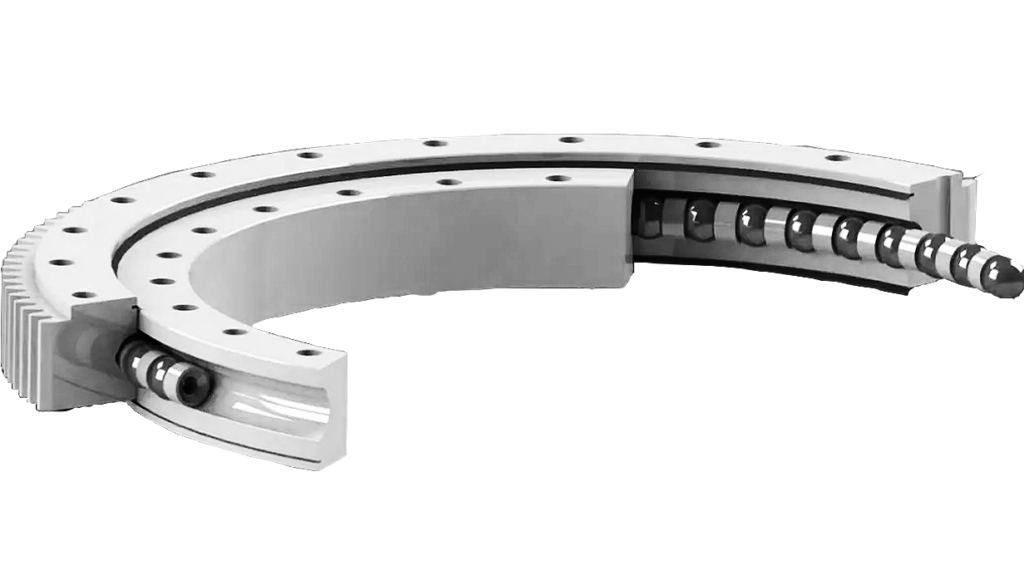
XIU30/1128 slewing bearing 936×1258mm
Cranes pivoting under load, robotic arms executing micro-adjustments, and surveying equipment tracking celestial movements all demand rotational stability without backlash. When designing a turntable joint that must absorb simultaneous axial, radial, and moment forces in a compact footprint, the engineering conversation shifts to crossed roller slewing bearings. The XIU30/1128 model enters this space with a geometry engineered specifically for high-rigidity applications.
At a glance
- Cranes pivoting under load, robotic arms executing micro-adjustments, and surveying equipment tracking celestial movemen
- The defining characteristic is the crossed cylindrical roller arrangement within a single plane. Unlike traditional four
Core Geometry and Load Distribution
The defining characteristic is the crossed cylindrical roller arrangement within a single plane. Unlike traditional four-point contact ball rings, this configuration places rollers at ninety-degree alternation inside the inner raceway. This cross-axis layout neutralizes skew moments and delivers uniform load distribution across the entire circumference. Procurement teams must understand that this design carries heavy combined loads without internal preload drift. Structural integrity directly impacts uptime in continuous rotation environments, minimizing deflection under heavy payloads.
Dimensional Profile and Mass Considerations
An inner diameter of 936 mm and an outside diameter of 1258 mm define the mounting envelope. The 86 mm total thickness keeps the profile slim compared to heavier double-row alternatives. Buyers calculate mounting flange requirements and center-of-gravity shifts using these exact boundaries. At 285 kg, standard overhead lifting protocols apply during installation. The internal gear tooth profile enables direct pinion drive coupling, eliminating secondary torque hardware and simplifying overall assembly architecture.
Precision Standards and Sealing Architecture
Rotational accuracy dictates whether equipment holds calibration tolerance after months of operation. This series offers P0, P6, and P5 grades, allowing engineers to match precision against budget constraints. Lower runout values suit optical positioning stages, while P0 satisfies general industrial automation. Double-sealed lip arrangements protect those precision surfaces by retaining lithium-complex grease while blocking abrasive particulates. Extended service intervals and consistent friction coefficients result directly from this sealing strategy.
Cage Material and Maintenance Parameters
The retention system utilizes a high-grade nylon composite cage. Polymer construction lowers rotational inertia compared to steel alternatives, reducing motor load during frequent cycling. Vibration damping improves operational quietness, though thermal limits require monitoring above 120°C continuous runtime. Maintenance focuses primarily on lubrication intervals and thermal management. Key inspection protocols include:
- Verify grease compatibility with existing polymer seals
- Monitor torque spikes indicating early cage fatigue
- Recheck mechanical preload after extended thermal cycling
Specification Verification
Purchasing decisions rely on exact dimensional references. The table below consolidates core manufacturing parameters for rapid engineering validation. Cross-check the SBI XIU30/1128 designation against legacy catalogs before issuing purchase orders. Our Crossed roller slewing bearings (Internal gear type) category hosts complete GD&T documentation. For catalog alignment, reference our bearing number reference database. Every assembly ships pre-inspected and ready for bolt-down integration. Contact FIJ Bearing engineering sales for torque specifications or custom machining. Request a quote through our direct portal to secure current inventory status and shipping timelines.