
QJ308MC3 Four-point contact ball Bearing — 40×90mm | Data
News & Updates
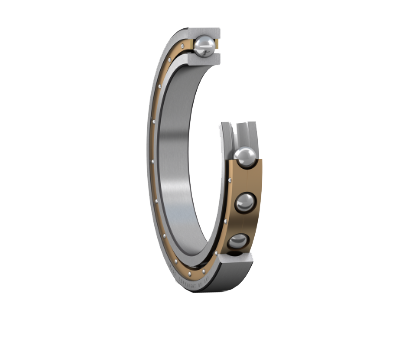
QJ308MC3 Four-point contact ball Bearing — 40×90mm | Data
For equipment designers comparing a single four-point contact ball bearing with a pair of angular contact bearings, the QJ308MC3 offers a compact 40×90×23 mm envelope and a different trade-off: one ring set carries combined radial and bidirectional axial loads without doubling the axial stack. That distinction matters in gearboxes, pumps, and accessory drives where the housing length is fixed before the bearing selection is finalized. The data below treats QJ308MC3 as an engineering package—boundary dimensions, load ratings, speed limits, cage and clearance—rather than a catalogue line.
At a glance
- Parameter: Value
- Bore diameter (d): 40 mm
- Outside diameter (D): 90 mm
- Width (B): 23 mm
Boundary dimensions and envelope fit
The QJ308MC3 is a 40 mm bore, 90 mm outside diameter, 23 mm wide bearing in the QJ3 series. Its 0.78 kg mass is consistent with a machined-brass-cage design in this size class. For mounting, the 40×90×23 mm envelope is usually the first gate: shaft diameter, housing bore, and axial space must all accept the bearing before load and speed are checked. A cylindrical bore is standard here, so the shaft fit and abutment geometry follow normal cylindrical-bore practice rather than a tapered adapter. The width also sets the effective shoulder span; a housing designed around a narrower bearing may need a spacer or a revised shoulder to avoid clamping the cage or loading the wrong ring face.
| Parameter | Value |
|---|---|
| Bore diameter (d) | 40 mm |
| Outside diameter (D) | 90 mm |
| Width (B) | 23 mm |
| Weight | 0.78 kg |
| Cage | Machined brass |
| Bore type | Cylindrical |
| Basic dynamic radial load rating (Cr) | 73681 N |
| Basic static radial load rating (Cor) | 981888 N |
| Reference speed | 6255 r/min |
| Limiting speed | 8324 r/min |
What the radial load ratings mean for QJ308MC3
FIJ lists 73681 N basic dynamic radial load rating and 981888 N basic static radial load rating for this bearing. The static value is much higher than the dynamic value, which is normal for a four-point contact ball bearing of this size: the balls and raceways can accept high static loads, but fatigue life under rotation is governed by the dynamic rating and the actual load spectrum. Do not treat 981888 N as a working load. Use it with an appropriate static safety factor for shock, standstill, or infrequent-motion conditions. The 73681 N dynamic figure should be combined with the application’s equivalent load, speed, and required L10 life. Four-point contact geometry lets one bearing support radial loads and axial loads in either direction, but the load path through the four contact points depends on clearance, preload, and the direction of the net axial force. A bearing that is lightly loaded axially may run on fewer contact points than a fully loaded one, so the mounting and preload decision is part of the rating calculation, not an afterthought.
Speed limits and thermal behavior
The reference speed is 6255 r/min and the limiting speed is 8324 r/min. These are not interchangeable targets. The reference speed is a thermal and lubrication reference under defined conditions; the limiting speed marks the upper boundary for mechanical and thermal operation with suitable lubrication and cooling. The gap between the two figures gives engineers room to evaluate heat generation, lubricant viscosity, and cage behavior. QJ308MC3 uses a machined brass cage, which is a robust choice for applications where speed, load, or lubrication transitions are less forgiving than a simple constant-speed drive. In practice, the permitted speed depends on the actual oil or grease system, preload, housing heat rejection, and whether the bearing runs near a seal or a hot shaft. A conservative design check should confirm that the planned operating speed sits below the limiting value with margin, and that the lubricant can carry heat away at the reference-speed condition.
Cage, clearance, and bore interface
The M in QJ308MC3 identifies a machined brass cage; the MC3 suffix is associated with C3 radial internal clearance in the QJ3 series. That combination matters during assembly. C3 clearance is not a licence to ignore fits: a heavy interference fit on the shaft or housing can consume clearance and change the four-point contact behavior. The cylindrical bore should be checked for roundness and taper, and the shaft shoulder should be square to the axis. For readers decoding suffixes across FIJ product families, the bearing number reference is useful before ordering or cross-checking a replacement. The cage should be treated as a precision component during handling; machined brass cages tolerate many industrial duties, but they can be distorted by uncontrolled pressing or by using the cage to transmit mounting force.
Mounting considerations
Mounting a four-point contact bearing is less forgiving than mounting a simple deep groove bearing because the contact pattern responds to axial location and preload. The following checks cover the main boundaries for QJ308MC3:
- Verify shaft and housing fits against the actual clearance class; do not assume that a standard fit used with a deep groove bearing will produce the same contact behavior.
- Support the mounted ring with a square, rigid shoulder and apply mounting force only to the ring being fitted.
- Set axial location and preload deliberately; excessive preload can raise torque and temperature, while too little axial control can allow load to concentrate on fewer contact points.
- Confirm lubrication volume and viscosity at the planned speed, especially if the bearing is the highest-speed element in the housing.
- Check alignment and shaft deflection under load; a four-point contact bearing can accommodate some misalignment, but it is not a self-aligning bearing.
These checks are particularly relevant when replacing a paired angular contact arrangement, because the axial space and shoulder locations may change even if the shaft diameter stays at 40 mm.
Four-point contact bearings in the assembly
Compared with a pair of single-row angular contact bearings, a four-point contact bearing can reduce axial length and simplify axial location: one bearing handles bidirectional axial load instead of two opposed bearings. Compared with a deep groove ball bearing, it can offer a more controlled contact geometry for combined loads, but it also demands more attention to clearance and preload. The trade-off is not automatic. If the application needs high radial stiffness or a wide speed margin, a paired angular contact arrangement may still be the better architecture; if axial space is tight and the load spectrum is predominantly combined, QJ308MC3 is a practical candidate. Engineers comparing layouts can review FIJ’s four-point contact ball bearings category for related sizes and mounting data, then check the specific load case against the ratings above.
Procurement checks and quote request
Before ordering QJ308MC3, confirm the drawing dimensions, clearance suffix, cage type, and lubrication requirement against the application. The 40×90×23 mm envelope and 0.78 kg mass are easy to verify; the more important checks are the equivalent load, speed margin, and axial setting. FIJ Bearing supplies precision bearings for OEM and maintenance programs, and the engineering team can review a mounting sketch or load schedule before release. A final inspection should include bore and outside-diameter measurement, clearance verification where specified, and a check that the cage is free of handling damage. For production quantities or replacement needs, request a quote from FIJ for QJ308MC3 with your drawing, annual usage, and delivery target.