
IGCRM slewing bearing 1665×2002mm
News & Updates
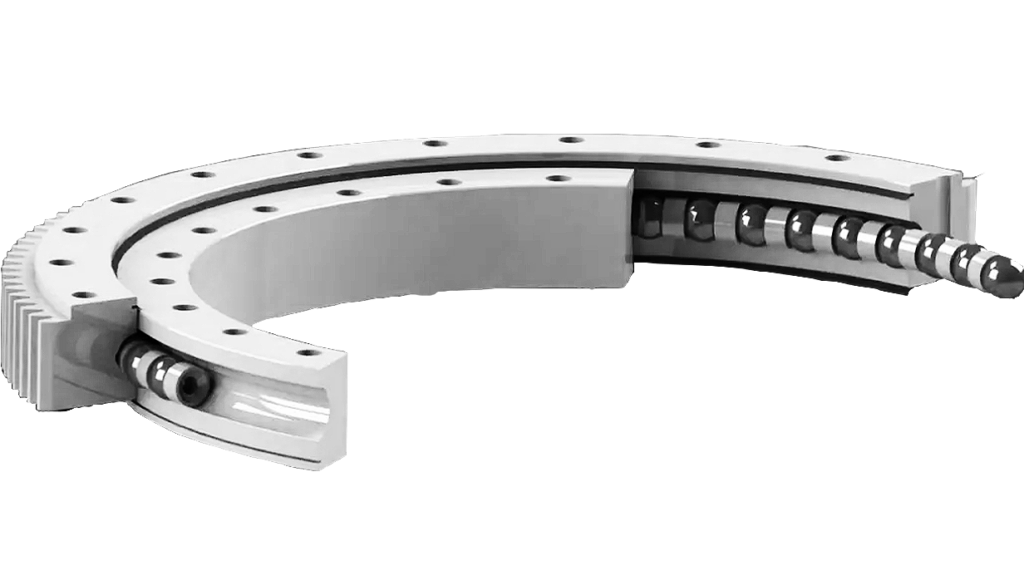
IGCRM slewing bearing 1665×2002mm
On a scrap-handling crane at a steel mill, the upper structure swings a 12-tonne grab across the yard several hundred times a shift. Every one of those swings passes through a single large ring: 1665 mm bore, 2002 mm outside diameter, 156 mm axial height, with an internal gear set that turns the whole upper works. That ring is the IGCRM 2002.1665.156, and reading its data sheet properly is the difference between a bearing that runs eight years and one that is back at the dock in eighteen months.
At a glance
- Parameter: Value
- Model / part number: IGCRM 2002.1665.156
- Bearing type: Crossed roller slewing bearing, internal gear
- Boundary dimensions (d × D × B): 1665 × 2002 × 156 mm
First, the Envelope: 1665 × 2002 × 156 mm
Three numbers define everything downstream, and each one constrains a different part of the machine design.
The 1665 mm inside diameter is the bore, and because this is an internal gear type, that space is not free clearance. The gear teeth are cut into the inner ring, so the pinion and its drive have to live inside the ring. If the machine also needs a hydraulic rotary union or a slip ring running down the centre, check the pinion’s swept envelope before you approve the layout. The 2002 mm outside diameter is the outer face of the ring and effectively the mounting envelope — the bolt circle and flange annular width both sit inside it. At 156 mm, B is the axial height: it fixes roller diameter and raceway depth, so it is the number that drives load capacity, and it also sets the stack height your upper structure has to absorb.
| Parameter | Value |
|---|---|
| Model / part number | IGCRM 2002.1665.156 |
| Bearing type | Crossed roller slewing bearing, internal gear |
| Boundary dimensions (d × D × B) | 1665 × 2002 × 156 mm |
| Mass | 912 kg |
| Roller rows | One |
| Cage material | PA6, PA1010 or PVC |
| Static axial load rating (C0a) | 5,710,000 N |
| Precision grade | P0, P6, P5 |
| Sealing | Double seal |
What the Internal Gear Ring Changes in Your Design
Putting the pinion inside the ring rather than outside it is not a cosmetic choice. It shortens the torque path, eliminates a separate ring gear and its bolted joint, and keeps the mesh shielded inside the bearing envelope where swarf, grit and weather are less likely to reach it. On a machine where the drive has to sit inside the turntable anyway, that is a real saving in height and in parts count.
The trade-offs are just as real. Gear lubrication and inspection have to be planned through access ports, the pinion alignment is set by the ring’s own mounting, and the structure supporting the ring has to be stiff enough that tooth deflection stays inside the design backlash. Buyers comparing this Crossed roller slewing bearings (Internal gear type) category against an external-tooth design should weigh those service requirements, not just the price column.
The 5,710,000 N Static Axial Rating, Put in Perspective
The catalogue figure is C0a = 5,710,000 N, roughly 582 tonnes-force. Set against a 912 kg ring, that is a ratio of about 640:1 between rated static load and its own mass — which tells you how much of the capacity in a crossed roller design comes from geometry rather than material. A single row of cylindrical rollers is arranged at 90° to its neighbours in a V-shaped raceway, so one raceway set carries axial load, radial load and tilting moment at the same time. Compared with a four-point contact ball ring in the same envelope, the line contact of the rollers gives higher stiffness and higher capacity.
That said, C0a is not a working load. It is the load at which the raceway would reach the defined limit of permanent deformation. In service you apply a factor — commonly 1.5 to 2 for smooth duty, higher where shock loads appear — and you check the combined load case rather than the axial number alone. On a crane or a handler, tilting moment usually governs the selection long before pure axial load does. Ask for the load curve.
Cage Material, Row Count and the Double Seal
The single row of crossed rollers is held by a segmented cage, and the material options here are worth a moment. PA6 is tough and inexpensive but absorbs moisture, so it needs attention in humid service or long storage. PA1010 takes up less water and holds dimensions better, which is why it is common on outdoor machinery. PVC brings chemical resistance and rigidity where washdown or aggressive fluids are present, with a lower practical temperature ceiling.
The double seal does more for service life than most buyers expect. Two lips retain grease and exclude grit, and at two metres diameter the seal also contributes meaningfully to starting torque. Confirm the relubrication interval and grease specification with the supplier before commissioning — a sealed ring still needs periodic grease at the raceway.
P0, P6 or P5: Precision You Can Actually Use
Precision grade sets the tolerance on raceway runout and rotational accuracy, and it moves both price and lead time. P0 is the standard class and covers most material handling, crane and construction equipment duty. P6 tightens the tolerances for machines that index position. P5 is the choice for rotary tables and positioning axes where angular error is measured, not just felt.
But there is a caveat that matters at this diameter. A two-metre ring is only as round as the flange it is bolted to. Mounting-flange flatness and bolt preload will dominate the running runout of the assembly far more than the grade stamped on the ring. A P0 IGCRM on a properly machined flange will generally rotate more smoothly than a P5 unit distorted by an out-of-flat foundation.
912 kg of Handling and Mounting Reality
At 912 kg, this is a crane lift. Use the lifting provisions, keep slings off the gear teeth and the seal lips, and never let the ring take load through a single point. Before bolting, check flange flatness around the full circumference, confirm bolt grade and preload values, and tighten in a controlled crossing sequence so the ring seats without distortion. Recheck gear backlash after the bolts are torqued, not before.
- Verify flange flatness and surface finish before the ring is lifted into place.
- Confirm bolt grade, lubricant and preload torque against the mounting drawing.
- Inspect seal lips and gear teeth for transport damage while the ring is still on the pallet.
- Set pinion backlash after final bolt tightening, then record it for commissioning.
- Charge the gear mesh and raceway with the specified grease before first rotation.
Cross-Referencing IGCRM 2002.1665.156 Correctly
Dimensionally interchangeable numbers exist for this size, and it is tempting to order on d × D × B alone. Do not. Two rings with the same envelope can differ in tooth module, tooth count, gear pressure angle, raceway capacity and seal design. Compare the gear data and the load rating, not just the three headline dimensions, and use the bearing number reference to map alternative numbering systems before you commit a purchase order.
For the IGCRM range, the practical route is to send the machine model, the original part number and a photo of the mounting flange along with your load case. FIJ Bearing manufactures these rings to the dimensions above and can confirm gear data, grade and sealing against your application before the drawing is released.
Request a quote for the IGCRM 2002.1665.156 from FIJ — send your drawing and duty cycle, and we will return pricing, lead time and a mounting check sheet.