
Rolling Bearing Survival at -253°C and 650°C Extreme Conditions
News & Updates
Rolling Bearing Survival at -253°C and 650°C Extreme Conditions
Rolling bearings rarely get top billing in a machine design, yet in extreme operating conditions they are frequently the component that decides whether the whole system works. From the vacuum of space to the pressure of the deep ocean, and from deep cryogenic cold to red-hot turbine environments, the demands placed on a rolling bearing go far beyond anything a standard test bench can reproduce.
This overview looks at the extreme edges of bearing operation — temperature, vacuum, and speed — and at the material and lubrication technologies that make them survivable.
Cryogenic Duty: Running at -253°C
In a liquid hydrogen and liquid oxygen rocket engine, the turbopump bearings sit directly in the path of propellant colder than anything found on Earth’s surface. At -253°C, ordinary bearing steel loses much of its toughness, standard greases become solid blocks, and dimensional clearances shift in ways a room-temperature design would never predict.
Meeting this challenge requires three things at once: a material that stays ductile, a lubrication method that does not depend on a conventional grease film — often the propellant itself, or a dry solid lubricant — and a cage and raceway geometry that tolerates thermal contraction without losing control of the ball set.
High-Temperature Bearings: Stable at 650°C
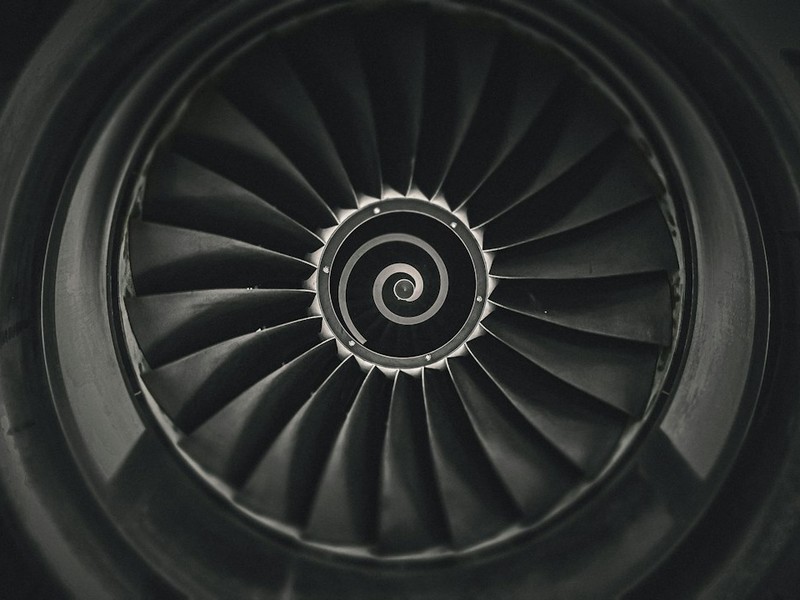
At the opposite end, modern aero engine bearings run continuously in environments approaching 650°C. Heat-resistant steels, hybrid ceramic designs, and solid or metallic lubricant systems are combined so the bearing keeps its load-carrying capacity after thousands of thermal cycles. Thermal expansion management matters just as much as material choice: bearing, shaft, and housing must expand in a way that maintains preload rather than destroying it.
Together, cryogenic and high-temperature duty describe what is often called the “ice and fire” of bearing engineering — two extremes that share a common answer: advanced materials plus engineered lubrication.
Space: The Lifetime Lubrication Problem
A satellite cannot be relubricated after launch. Missions lasting years, sometimes more than a decade, must run on the grease that was in the bearing on day one — lifetime lubrication in the literal sense. That puts unusual pressure on:
- Grease formulation, including low outgassing and low vapor pressure in vacuum
- Sealing and shield design that retains lubricant without adding torque
- Cage materials that do not shed particles or cold-weld in vacuum
- Running-in procedures that establish a stable film before launch
High Speed: Nanometer Accuracy at 15,000 rpm
Speed brings its own physics. When hard disk drive spindle motors moved from 7,200 rpm to 15,000 rpm, non-repeatable runout requirements tightened into the nanometer range. At that level, ball roundness, raceway geometry, cage balance, and lubricant film thickness stop being secondary details and become the limiting factors of the entire design.
High-speed spindles in machine tools face the same convergence: the faster the spindle, the more the bearing determines surface finish and tool life. Choosing between a Precision ball bearing and a Precision roller bearing for a given speed and load envelope is therefore a system-level decision, not a catalogue lookup.
Ceramic Bearings: Low Density, High Hardness
Ceramic rolling elements — typically silicon nitride balls running in steel rings — have become one of the most visible directions in rolling bearing development. Their advantages are straightforward: roughly 40 percent lower density than steel, high hardness, and excellent corrosion resistance. Lower mass means lower centrifugal load at high speed, which reduces skidding and heat generation. The result is longer life in machine tools, electric vehicle drivetrains, aerospace accessories, and chemical processing equipment.
Full ceramic bearings extend the same benefits to aggressive media, while hybrid designs keep cost and load capacity within reach of mainstream applications. For rotating equipment that must also handle combined loads and slow indexing motion, Precision slewing bearing designs follow similar material logic.
What This Means for Bearing Selection
Extreme applications are not a niche — they define where bearing technology is heading. A few practical takeaways:
- Temperature defines the material and lubrication system before it defines the bearing type
- Access for relubrication decides whether lifetime lubrication is a requirement or an option
- Speed pushes the design toward tighter geometry control and lighter rolling elements
- Environment — vacuum, corrosion, contamination — often rules out otherwise ideal solutions
Every advance at these limits comes from the same combination: materials science, tribology, and precision manufacturing working together. FIJ manufactures precision rolling bearings for demanding duty cycles and helps engineers match bearing type, material, and lubrication to the real operating envelope rather than a nominal rating.