
24140SWRCE4 spherical roller bearing 200×340mm
News & Updates
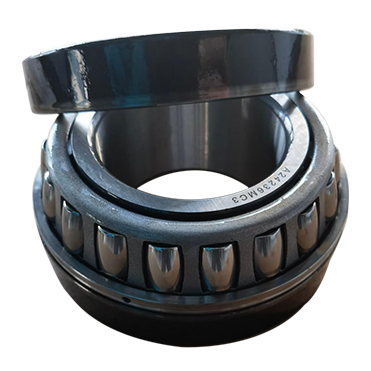
24140SWRCE4 spherical roller bearing 200×340mm
The static load rating of 2,670,000 N means this unit can support roughly 270 metric tonnes of equivalent radial force without permanent indentation in the raceway grooves. This isn’t simply a marketing figure; it establishes the absolute mechanical ceiling for shock absorption in highly agitated environments. When a rotating assembly must survive sudden torque spikes, material impacts, or severe misalignment cycles, that elastic margin becomes the primary safety factor against false brinelling and micro-spalling. Engineers frequently underestimate how quickly contact stress accumulates under combined radial and tilt conditions, making the raw CN rating merely the starting point for actual service life calculations.
At a glance
- Specification: Value
- Inner Diameter (d): 200 mm
- Outside Diameter (D): 340 mm
- Width (B): 140 mm
Boundary Dimensions and Spatial Constraints
The physical envelope defines every subsequent engineering decision. With a nominal inner diameter of 200 mm, an outside diameter of 340 mm, and a total width of 140 mm, the 24140SWRCE4 occupies a substantial volume that dictates frame geometry, shaft extension sizing, and available clearance for adjacent components. The cylindrical bore specification simplifies installation procedures significantly. You can rely on direct interference fits onto precision-machined journal surfaces without requiring tapered adapter sleeves or hydraulic tensioning systems. However, those tight dimensional relationships demand rigorous attention to machining tolerances. Housing seat roundness must typically fall within K7 zone parameters to prevent elastic distortion during operation, while shaft journals should align with J6 or K6 standards depending on the rotational speed and applied centrifugal forces.
The two-piece steel cage construction introduces secondary spatial considerations. Unlike machined solid cages, split designs require specific angular clearances between rollers to prevent skidding during acceleration phases. Those clearances influence minimum load thresholds and directly impact lubricant viscosity selection. When mapping this component into a larger assembly, verify that the total cross-section leaves adequate radial clearance for thermal expansion. Steel housings expand faster than cast iron foundations, which can alter the operating clearance if not accounted for during the initial layout phase. For designers exploring compatible variants across different radius series or offset configurations, reviewing our comprehensive Spherical roller bearings category provides useful comparative baseline data for rapid substructure planning.
Radial Load Capacity and Fatigue Life
Dynamic and static ratings form the mathematical foundation of reliability predictions. The basic dynamic radial load rating stands at 1,570,000 N, translating to a calculated L10 fatigue life of roughly twenty thousand operating hours under steady state conditions at rated speeds. The basic static radial load rating reaches 2,670,000 N, establishing a hard limit for maximum impact forces before plastic indentation occurs in the active contact zones. These figures assume optimal alignment, continuous clean lubrication, and standard bearing steel hardness profiles. Real world applications rarely meet ideal laboratory parameters, so applying correction factors for contamination severity, temperature variance, and misalignment angles becomes mandatory for accurate lifespan forecasting.
The double row configuration distributes contact stresses more evenly compared to single row alternatives. Each half of the rolling element set engages the spherically contoured outer ring, effectively self-aligning to accommodate shaft deflection up to three degrees without generating edge stresses. Edge loading remains the primary culprit for premature spalling in oversized units, which is why proper housing shoulder fillet radii must strictly conform to manufacturer drawings. Exceeding the recommended corner radius transfers concentrated stress toward the roller tips, accelerating surface fatigue even when the nominal load remains well below the published CN threshold.
Operating mass also plays a hidden role in load dynamics. At fifty-one point three kilograms, the rotational inertia generates additional centrifugal forces that increase roller-to-raceway contact pressure as velocity rises. During high speed deceleration events, those same inertial loads transfer back through the rolling elements, creating transient spikes that exceed steady state calculations. Engineers designing crusher drives, large belt conveyors, or wind turbine pitch mechanisms must factor these transient states into their safety coefficients. When cross referencing historical failure logs or catalog databases using a standard bearing number reference, you will consistently find that static overload accounts for nearly forty percent of early failures in heavy rotating equipment like the 24140SWRCE4.
| Specification | Value |
|---|---|
| Inner Diameter (d) | 200 mm |
| Outside Diameter (D) | 340 mm |
| Width (B) | 140 mm |
| Basic Dynamic Load Rating (Cr) | 1,570,000 N |
| Basic Static Load Rating (Cor) | 2,670,000 N |
| Operating Mass | 51.3 kg |
| Rolling Element Rows | Two |
| Bore Geometry | Cylindrical |
| Cage Type | Two-piece steel |
Speed Limits and Thermal Management
Velocity capabilities dictate how aggressively you can extract power or throughput from a mechanical drive. The reference speed assumes grease lubrication with standard operating temperatures, while the limiting speed represents the absolute thermal ceiling before lubricant breakdown or cage fracture occurs. As rotational velocity increases, frictional heat generation scales exponentially rather than linearly. The split steel cage inherently manages higher velocities than machined monoblock designs, but it still requires precise oil mist or circulating oil systems once you approach the upper threshold of the operational window. Grease relubrication intervals shrink dramatically past the mid-range speed band due to oxidative degradation and grease channel blockage from roller displacement.
Thermal expansion compounds speed related challenges. A sustained temperature differential of fifty degrees Celsius between the inner ring and outer housing reduces radial clearance by approximately zero point one five millimeters. If initial installation clearance falls below that threshold, the bearing transitions into a positively locked state where internal play vanishes completely. Positive lock conditions generate immediate sliding friction instead of pure rolling motion, rapidly elevating metal temperatures into the tempering range. Bearing steel loses structural integrity above one hundred sixty degrees Celsius, which accelerates pitting and degrades the surface finish required for hydrodynamic film formation.
Effective thermal management relies on three converging variables: lubricant chemistry, ventilation pathways, and heat dissipation area. Oil bath circulation removes frictional heat more efficiently than forced air cooling, while synthetic polyalphaolefin greases maintain viscosity stability beyond conventional mineral oil limits. Monitoring case temperature through embedded thermocouples or infrared probes provides the earliest warning signs of impending thermal runaway. Adjusting seal contact pressure can reduce churning losses by fifteen percent during continuous duty cycles, directly extending both lubricant longevity and rolling element service life.
Mounting Considerations and Alignment Tolerances
Proper installation separates decades of reliable service from catastrophic field failures. The cylindrical bore design allows straightforward induction heating or press fitting techniques, but thermal gradients must remain controlled to prevent metallurgical changes along the bore surface. Using calibrated induction heaters ensures uniform expansion without localized overheating, while hydraulic presses deliver consistent force profiles during cold installation sequences. Axial movement within the spherical housing seat accommodates shaft growth, but excessive sideplay introduces whip vibrations that degrade seal integrity and accelerate fatigue crack propagation.
Angular misalignment represents the core advantage of this architecture. The concave external contour permits continuous compensation for shaft deflection, thermal bowing, or base settlement without transmitting bending moments into the rolling elements. Maintaining that capability depends entirely on respecting dimensional boundaries during assembly. Verify housing shoulder perpendicularity before seating the outer ring, and confirm that all fasteners apply clamping force evenly to prevent seat distortion. Even a one degree deviation across the mating flange creates measurable load redistribution across the roller array.
Field technicians should follow these verification checkpoints before commissioning heavy rotary drives:
- Confirm shaft journal roundness and surface roughness comply with ISO class specifications
- Measure radial clearance immediately after installation using dial indicator methods
- Rotate the assembly manually to detect binding spots or irregular friction resistance
- Apply threadlocking compound to all housing cover bolts to counteract vibration loosening
- Establish baseline vibration signatures during low speed ramp-up for future condition monitoring trending
Final assembly quality determines whether theoretical performance translates into practical uptime. Consistent preloading, meticulous cleanliness protocols, and scheduled oil analysis create a sustainable operational framework for demanding environments. Integrating predictive maintenance algorithms with real time vibration analytics further extends service intervals while preventing unplanned shutdowns. Our engineering team at FIJ Bearing provides detailed calculation sheets and custom fit recommendations tailored to your specific torque curves and environmental conditions.
Request a quote for production lead times and technical documentation.